Purple4Life - Innovative, sustainable, and circular production of purple phototrophic bacteria as a health-promoting ingredient for food and feed applications. The European project Purple4Life has been selected for funding under the Circular Bio-based Europe Joint...
Within the framework of the Purple4Life project, CNR is developing a safety assessment workflow for PPB, focusing on their suitability as innovative food and feed ingredients What is being developed CNR is developing and applying protein allergenicity assessment...
Within Purple4Life, the team at the Universidad Rey Juan Carlos (URJC) develops bioelectrochemical technologies to convert CO₂ contained in biogas into high-value microbial biomass.
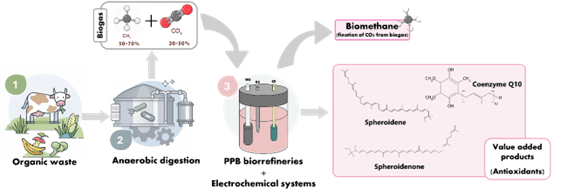
Our approach integrates bioelectrochemical system (BES) with purple phototrophic bacteria (PPB) to simultaneously upgrade biomethane and generate antioxidant-rich biomass containing carotenoids and coenzyme Q10 (CoQ10).
Infographic showing the conversion of organic waste through anaerobic digestion and electrochemical biorefineries into biomethane and value-added antioxidant compounds. Source: URJC, own elaboration.
Our work positions bioelectrochemistry as a powerful platform to modulate the metabolic response of purple phototrophic bacteria, controlling the electron fluxes toward CO₂ fixation, biomass formation, and/or the synthesis of high-value compounds.
What is being developed: photo-bioelectrochemical reactors for antioxidant production
At URJC, we are developing photo-bioelectrochemical reactors that couple extracellular electron supply with the growth of PPB to promote CO₂ fixation and the production of antioxidant. These systems are based on microbial electrolysis cell (MEC) configurations in which the cathode acts as a continuous and tunable electron donor, driving PPB toward a photoelectroautotrophic metabolism.
Our work combines reactor engineering with strain selection. Four Rhodopseudomonas strains, including the model electroactive strain Rhodopseudomonas palustris TIE-1 and URJC isolates, are being progressively acclimatized to electrode-driven conditions. Their performance will be evaluated based on CO₂ fixation rates, electron uptake, biomass productivity, and the accumulation of antioxidant compounds such as carotenoids and coenzyme Q10.
Electrochemical techniques, metabolic profiling, and physiological analyses will be integrated to determine how cathodic redox pressure modulates phenotypic and metabolic shifts.
Why it matters: overcoming dependency on soluble electron donors
Conventional PPB growing strategies rely on soluble organic substrates, such as volatile fatty acids (VFAs), to provide energy and carbon. However, these compounds increase operational costs and require storage and transport infrastructure. At the same time, biogas generated from anaerobic digestion processes often contains insufficient methane content to meet grid injection standards. Indeed, biogas generated from anaerobic digestion processes contains contaminants such as CO2 and N2 that reduces its calorific value and hinders to meet grid injection standards.
Bioelectrochemistry addresses both challengessimultaneously. By replacing soluble electron donors with a continuous electron flux supplied directly from the electrode, it enables precise redox control without the logistical constraints associated with organic substrates. In parallel, biological carbon fixation within the reactor reduces CO₂ concentration in biogas streams, contributing to biomethane purification while generating antioxidant-rich biomass as a secondary value stream.
In this way, photo-bioelectrochemical systems function as integrated platforms that simultaneously enhance renewable energy upgrading and enable the sustainable production of high-value bioactive compounds.
Team perspective
Our research bridges microbial physiology and electrochemical engineering. The key challenge is not only achieving CO₂ fixation but understanding how cathodic electrons are modulating the metabolic response. We focus on identifying which metabolic sinks dominate under different redox pressures, and how this influences biomass composition, carotenoid accumulation and CoQ10 synthesis.
By combining electrochemical control with microbial strain selection, we aim to design systems that are both biologically robust and industrially scalable.
What comes next
In the next phase, four Rhodopseudomonas strains (including TIE-1 and URJC isolates) will be progressively acclimated adapted to electroactive conditions. The most electroautotrophically robust strain will be selected for system optimization and pilot-scale validation.
This work will provide the technological foundation for integrating electrode-driven PPB cultivation into sustainable biogas upgrading platforms within Purple4Life, while advancing new bioelectrochemical routes to produce high-value antioxidant compounds.
Daniel Puyol (URJC)
Manage Consent
To provide the best experiences on purple4life.eu, we use technologies like cookies to store and/or access device information. Consenting to these technologies allows us to process data such as browsing behaviour or unique identifiers on this website. Not consenting or withdrawing consent may adversely affect certain features and functionalities.
Functional
Always active
The technical storage or access is strictly necessary for the legitimate purpose of enabling the use of a specific service explicitly requested by the subscriber or user, or for the sole purpose of carrying out the transmission of a communication over an electronic communications network.
Preferences
The technical storage or access is necessary for the legitimate purpose of storing preferences that are not requested by the subscriber or user.
Statistics
The technical storage or access that is used exclusively for statistical purposes.The technical storage or access that is used exclusively for anonymous statistical purposes. Without a subpoena, voluntary compliance on the part of your Internet Service Provider, or additional records from a third party, information stored or retrieved for this purpose alone cannot usually be used to identify you.
Marketing
The technical storage or access is required to create user profiles to send advertising, or to track the user on a website or across several websites for similar marketing purposes.